Spot vs Futures Trading
Spot vs futures for algo traders—risk, leverage, and how Algolingo strategies should differ.
By Algolingo
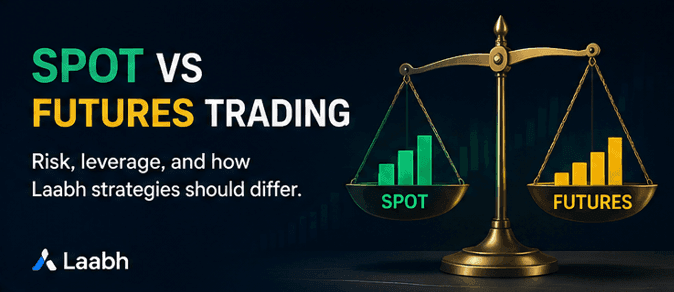
Spot vs futures trading is the first risk decision every algo trader should make—before picking RSI settings or a grid width. Spot automation means you own the asset (or quote currency) after fills. Futures automation means you trade contracts with leverage, funding, and liquidation risk. Both can be automated with a crypto trading bot; they should not use the same risk template.
Spot vs futures: core differences
| Topic | Spot trading | Futures trading | | --- | --- | --- | | Ownership | You hold the asset | You hold a derivative position | | Leverage | Typically none (or borrow products) | Explicit leverage / margin | | Downside | Price can fall; no classic liquidation of a long spot bag | Liquidation if margin is exhausted | | Funding | Usually N/A for plain spot | Periodic funding payments | | Bot complexity | Lower operational risk | Higher—stops and size are mandatory | | SEO intent | “spot trading bot”, DCA, grids | “futures bot”, funding, liquidations |
When spot automation is the better default
Choose spot trading bots when you:
- Are new to crypto algo trading
- Want DCA or long-term accumulation
- Prefer simpler tax/ops mental models (jurisdiction-dependent)
- Need strategies that survive mistakes without forced liquidation
Spot grids and indicator bots still lose money—they just fail slower and with clearer asset balances. Start here with a DCA bot or grid trading bot on liquid pairs.
When futures bots make sense
Futures trading bots fit traders who already:
- Understand margin, mark price, and funding
- Can define max leverage and max daily loss in writing
- Need shorting or capital-efficient exposure
- Will monitor funding regimes that can invert strategy PnL
Popular searches include Binance futures bot and CoinDCX futures bot. Those strategies need hard stops—see Binance futures bot and CoinDCX futures trading bot.
How strategy design should differ on Algolingo
Treat spot and futures as different products, even if the signal looks identical.
Spot strategy checklist
- Universe of pairs and quote currency
- Entry rules (indicator / schedule / grid bands)
- Exit rules and rebalancing cadence
- Max capital allocated per bot
Futures strategy checklist
- Everything above, plus:
- Max leverage and margin mode understanding
- Liquidation buffer and stop-loss automation
- Funding awareness for hold times
- Smaller size until behavior matches expectations
Algolingo is designed so risk rules sit next to execution—use that for futures especially. Related: crypto risk management and stop-loss automation.
Fees, funding, and “phantom” edges
A backtest that ignores:
- Taker fees on every grid fill
- Funding on multi-day futures holds
- Slippage on thin alts
…will look profitable and fail live. Spot vs futures is also a cost structure choice, not only a directional choice.
Practical path: spot first, futures later
- Automate one spot strategy on a major pair
- Log every fill and skipped signal for two weeks
- Only then clone the idea to futures with lower size and hard caps
- Never raise leverage to “fix” a losing bot
FAQ: spot or futures for algo trading?
Is futures better for bots because of leverage?
Leverage increases outcome variance—not edge. Most beginners should automate spot first.
Can the same indicator work on both?
Yes, but position sizing and exits must change. A Supertrend long on spot is not the same risk as 10x Supertrend on perpetual futures.
What about grid bots?
Spot grids are common for ranging markets. Futures grids need liquidation-aware sizing. Compare grid bot vs DCA bot.
Automate with Algolingo
Whether you run spot DCA or carefully capped futures rules, Algolingo helps you connect supported exchanges, configure strategies, and keep risk visible.
Create your Algolingo account and automate your next strategy.