Grid Bot vs DCA Bot
Grid bot vs DCA bot: ranging vs accumulating. Pick the right automation and run it on Algolingo.
By Algolingo
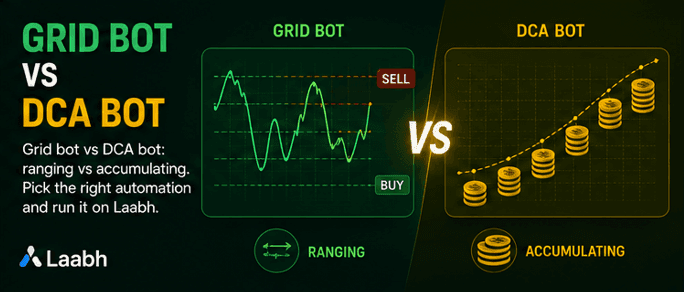
Grid bot vs DCA bot is one of the most practical strategy comparisons in crypto trading automation. Both are popular no-code starting points. They solve different market problems: grids harvest range volatility; DCA accumulates through uncertainty on a schedule or dip rule. Pick wrong, and the bot “works” while your inventory or cash timing fights the trend.
Grid bot vs DCA bot: quick table
| | Grid trading bot | DCA bot | | --- | --- | --- | | Market fit | Sideways / mean-reverting ranges | Uncertain or long-term bullish bias | | Mechanic | Buy low / sell high inside bands | Buy fixed notional on interval or condition | | Inventory risk | Can fill with bags in a crash | Increases average size over time | | Profit style | Many small round-trips | Basis cost reduction / long exposure | | Fee sensitivity | High (many fills) | Lower (fewer scheduled buys) | | Best first use | Liquid majors in a defined range | Building a spot position calmly |
How a crypto grid bot works
A grid trading bot places layered buys and sells across a price range. In a healthy range, fills recycle inventory for repeated small gains. In a breakout:
- Upside breakouts may leave you underinvested
- Downside breaks leave you holding inventory bought on the way down
Grids need bounded capital, liquid pairs, and a plan when price leaves the grid. Deep dives: grid trading bot and Binance grid trading.
How a DCA bot works
A DCA bot (dollar-cost averaging) buys on a time schedule (and sometimes on dips). Psychology is simpler: you are accumulating, not hunting microscopic mean reversion. DCA underperforms lump-sum in strong one-way rallies and outperforms emotional all-in/all-out behavior for many retail traders.
See DCA bot.
Which should you automate first?
Start with DCA if you:
- Want spot exposure without timing perfection
- Are new to bots and risk ops
- Trade majors (BTC/ETH) with a multi-month horizon
Start with grids if you:
- Have a credible range thesis and liquid pair
- Understand fee drag
- Can pause or widen grids when volatility regime changes
Many traders run both: DCA for core holdings, a small grid for range-bound alts—never with unbounded size.
Spot vs futures grids and DCA
Spot DCA/grids are the default for beginners. Futures grids add leverage and liquidation risk—advanced only. Re-read spot vs futures trading before enabling futures automation.
How to run either bot on Algolingo
- Connect a supported exchange with trade-only API keys
- Choose grid or DCA parameters (range, interval, size)
- Cap total capital and optional daily loss
- Monitor fills for the first week obsessively
- Adjust rules in writing before changing live settings
Algolingo keeps strategy configuration and risk next to execution so automation stays disciplined.
Common mistakes
- Grid too tight on a trending market
- DCA size too large relative to total portfolio
- Ignoring fees on high-frequency grids
- No exit plan when thesis breaks
- Copying someone else’s parameters blindly
FAQ: grid or DCA?
Is a grid bot more profitable than DCA?
Only in the right regime. There is no universal winner—match tool to market.
Can I combine them?
Yes: DCA core, grid satellite. Keep combined risk visible.
What pair is best?
Liquid majors first. Thin alts amplify slippage and gap risk.
Automate with Algolingo
Configure grid or DCA strategies on supported exchanges, enforce risk rules, and run bots without local servers.
Create your Algolingo account and automate your next strategy.